Like the transmission of any type of electromagnetic wave, a laser beam also has electric and magnetic component vectors that are at 90° to each other and perpendicular to the direction of beam propagation. In the field of optics, the electric vector is taken as the polarization direction of the laser beam. When fully automatic laser cutting machines cut metals and ceramics, the obviously inconsistent cut edge quality—such as changes in kerf, cut roughness, and verticality—is caused by the polarization effect, which can affect the degree to which the beam energy instantaneously coupled into the material is absorbed.
The polarization of the laser beam has a great influence on cutting quality and efficiency. If linearly polarized light is used for cutting, the cutting direction changes relative to the polarization direction of the beam, and the absorption ratio of the laser at the cutting front changes accordingly, thereby affecting the efficiency of laser cutting.
① When the cutting direction is parallel to the polarization direction, the absorption ratio of the laser at the cutting front is the highest, so the kerf is narrow, the verticality and roughness of the cut are low, and the cutting speed is fast, as shown in Figure 4.22(a).
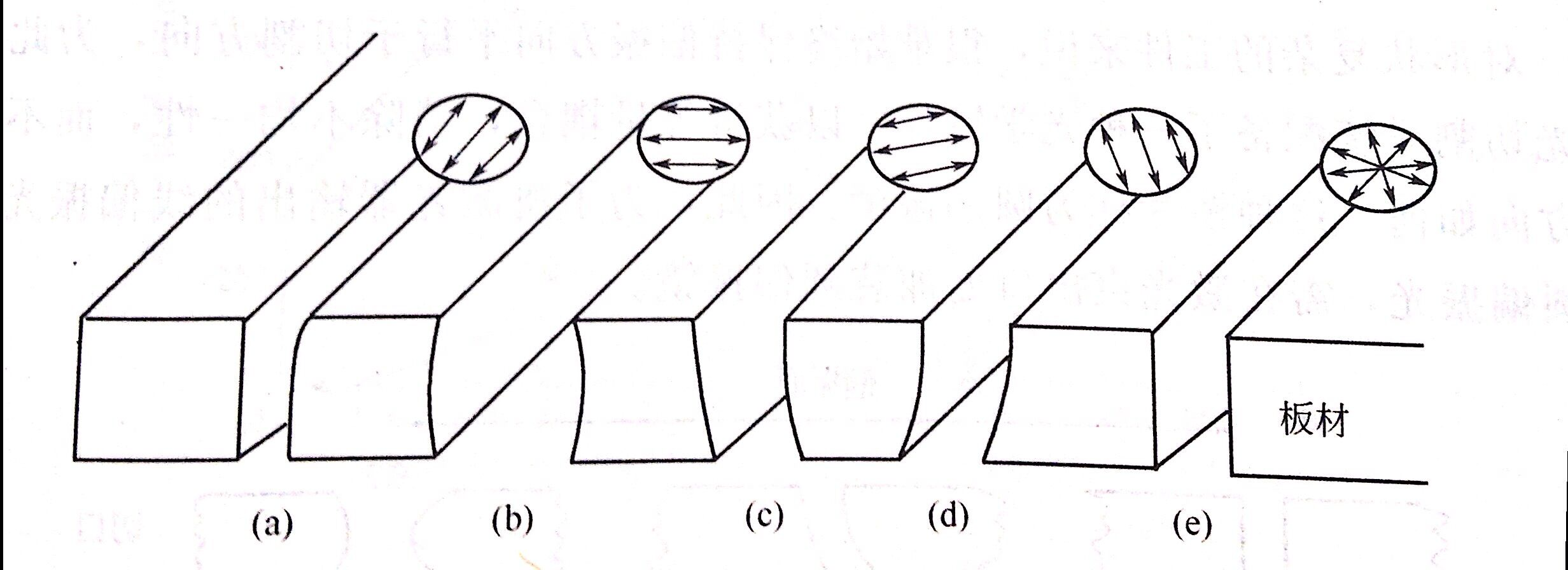
② When the cutting direction is perpendicular to the polarization direction, the reflection ratio of the laser at the cutting front is the highest and the absorption ratio is the lowest, while the transverse absorption ratio increases instead. Therefore, the cutting speed decreases, the kerf becomes wider, and the roughness of the cutting surface increases, as shown in Figure 4.22(b).
③ When the cutting direction forms an oblique angle with the polarization direction, the direction of maximum laser absorption also forms an angle with the cutting direction. If deflection occurs in the lower part of the kerf, it is as shown in Figure 4.22(c) and (d).
④ To prevent changes in kerf shape and cutting surface quality caused by changes in the cutting direction, circularly polarized light should be used for cutting. The electric vector amplitude of circularly polarized light is equal in all directions, and the absorption ratio of the laser at the cutting front does not change with the cutting direction, resulting in a uniform and neat kerf, as shown in Figure 4.22(c).
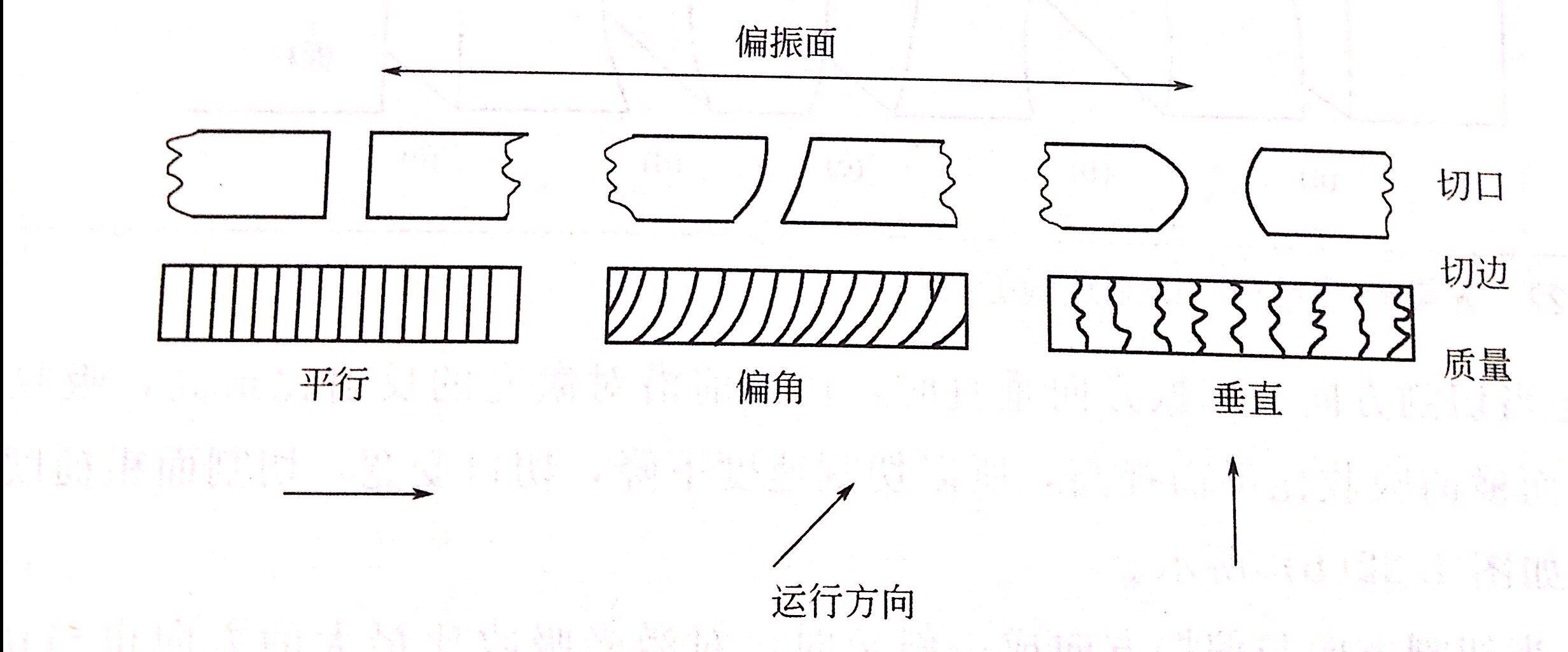
The influence of the polarization characteristics of the laser beam on laser cutting quality is shown in Figure 4.23. The influence of the beam polarization phase (parallel, oblique, perpendicular) on kerf quality is shown in Figure 4.24. When the cutting direction is parallel to the beam polarization, the kerf is narrow and the cut edge is straight. Moving the cutting direction away from the polarization plane leads to a gradual decrease in energy absorption; the slower the cutting speed, the wider the kerf, the rougher the cut edge, and the more perpendicular it is to the material surface. Once the cutting direction is completely perpendicular to the polarization plane, the cut is no longer inclined; the slower the cutting speed, the wider the kerf, and the rougher the cutting quality appears.
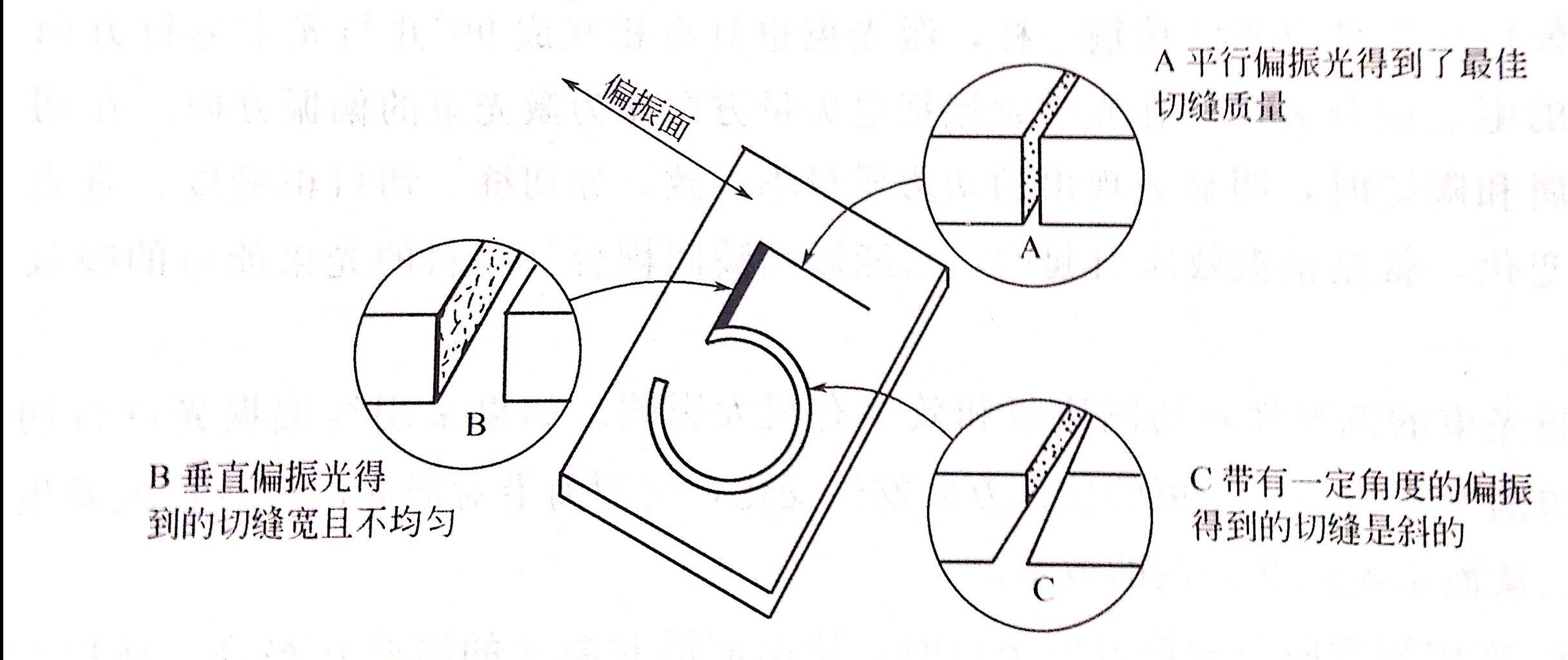
For workpieces with complex geometries, it is difficult to always keep the polarization direction parallel to the cutting direction. For this reason, modern laser cutting systems are equipped with an optical lens to achieve equal coupling and eliminate non-uniformity regardless of the cutting direction. This lens is called a circular polarizer. Therefore, in order to convert the linearly polarized light output by the laser into circularly polarized light, a circular polarizer needs to be installed at the laser beam exit.